4/30/09

Despair:Kindness

Lago Managua as Hades

Despair. Yes, I am now in the grip of a deep and seemingly unending despair. Once I took a measure of comfort, even pride, from Sartre's dictum that "life begins on the other side of despair". After a bout of depression, there is a return to a semblance of clarity of vision, a sense of a weight having been lifted that does indeed feel as though life begins anew. I now think he was mistaken, that he was in fact speaking of depression. But, although the two conditions do share common ground, they are not congruent. It is possible to be depressed without despair, and, as odd as it may appear, it is possible to face despair without depression.

I have written about depression and creativity, now I want to talk about despair and kindness. A recent I Ching reading informed me that "Words have influence only when they are pertinent and clearly related to definite circumstances. General discussions and admonitions have no effect whatsoever", reinforcing my perception that it is the most intimately personal that is most apt to strike a chord in a reader. Some have suggested that it requires courage to expose myself so nakedly. No, for despair strips away all shame, all pride.

So what is this despair? It is not the loss, or the absence, of hope. On the contrary, hope does indeed spring eternal. But now the hope that greets me each dawn is a cruel blade, for on its heels must come the knowledge that the dream is now lost forever. I once, I do not remember how many years ago, wrote a note that "home is a feeling in the heart where I, that place and that time are sufficient". It has been made plain to me that my heart is not sufficient. I have never known "home", I never shall. Still less share a home with another. The dreams to which I have awoken each day are now, forever, out of reach. I live in the sad certainty that I shall never know joy's embrace. It is not a question of a broken heart, but a broken spirit.

I have asked myself how I have arrived at this desolate place. The simple answer that remains when all is stripped away, is unkindness. Such a small word to lie at the heart of so much pain - and when I say this I speak not of my own alone, but all the tragic unnecessary suffering abroad in the world. Life, the world we live in, bring unkindness into our lives: cruel accidents, disease, hunger. These are our lot to bear. They are not assigned fairly, indeed it may often seem that fate singles out for special suffering those who least deserve it. But there is no malevolent agency behind this cruelty, this unkindness endemic to our world, none at least that we can identify. Though that has not prevented the naming of "god" or "the devil" as responsible by those unable to come to terms with the ugly truth that quite simply "shit happens". No the unkindnesses I speak of are those unnecessary, heedless acts of cruelty, great and small, deliberate or simply unthinking that we do to each other every day. And despair arises from my own seeming inability to curb my own acts of cruelty, let alone the vast injustices heaped on so many other innocents, and finally my inability to bear the weight of the losses of a lifetime. Call me weak, if you will, but I was there before you.

Christopher Isherwood wrote that "Even the most trivial unkindness is heartbreaking". A profound truth. But perhaps the converse is also true? Is even the most trivial kindness healing? Surely it cannot be harmful, at least? Many years ago I made a rule for myself that every day I would bring a smile, even laughter, to a stranger. I like to think that this may in some way mitigate all my unkindnesses, and, what has always troubled me more, all my intended kindnesses that have somehow made things worse. This is not altruism, these gestures are intended to bolster my own sense of worth. But, if indeed there is good here, is that good any the less for my selfish motive?

I find now some solace, some response to, and defense against this despair in raising my voice, however feebly, against injustice, cruelty, unkindness in all its forms. I do my poor best to offer counsel and comfort to those others, so many too many, that I know or meet and who are bearing their own burdens of unkindness. If I raise my voice against war, torture, the hideous crimes committed in our name in the Congo and all over the world where the weak, the poor are exploited and worse, if I speak out I am in reality speaking out against those who have wronged me. Is this dishonest? Does it make me a hypocrite if I seek some kind of comfort for myself in making this utterly inadequate gesture against the unimaginable suffering of these strangers? Is my anger against injustice any less genuine if its root lies in my rage at injustices that I imagine I have been subjected to? And if I answer that I do not care to any of these questions, does that make me somehow less of a man, less human?

I do not know. It is not important. Like all of us, I am doomed to live until I die. As I wait, I find I must try to be honest, try to be kind. I must speak out. Despair demands it. Despair is the true death of the spirit. Despair, not hatred is the true opposite of love, which is to say life. Kindness is the simplest, most direct expression of love. No matter how final despair might be, a million cells raise their voices for life, for love, for kindness. I am powerless to deny them.

Read This and Weep

"In February 2007, a protected prosecution witness gave evidence at the trial of seven senior Bosnian Serb army officers, charged with the massacre of up to 8,000 Muslim men and boys at Srebrenica in 1995. The witness had been a driver, delivering food and drink to the executioners as they lined up their victims and sprayed them with gunfire.

And then, suddenly, the shooting stopped. A very young boy emerged from the heap of bodies, covered in blood and mangled flesh. He began walking toward the gunmen, crying for his “Babo” (father). The soldiers lowered their weapons. The commanding officer ordered them to shoot the boy, but they refused, telling him to do it himself. The witness intervened on behalf of the boy: “All of a sudden he took me by the hand. . . . I don’t want any one of you to experience that, . . . the grip, the grip of him on my hand, and I was amazed at his strength.” He took the boy to his van and put some music on, while the gunmen returned to their work.

Later in February 2007, another witness testified at the Srebrenica trial. It was the boy (now a young man) who had crawled out from the pile of corpses."

From a review in NYT of MADAME PROSECUTOR - Confrontations With Humanity’s Worst Criminals and the Culture of Impunity: A Memoir By Carla Del Pontewith Chuck Sudetic (Amazon)

4/29/09

War - Torture - Violence

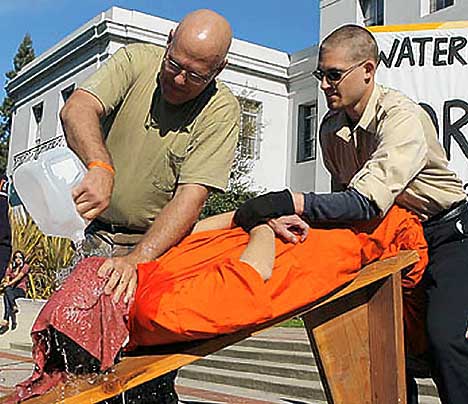
Waterboarding

A recent New York Times opinion piece "Torture Versus War" asks "What is it about the terrible intimacy of torture that so disturbs and captivates the public? Why has torture long been singled out for special condemnation in the law of war, when war brings death and suffering on a scale that dwarfs the torture chamber?" The author then proceeds to indulge in some hand-wringing over the effectiveness of torture in eliciting information, and to a lesser extent its legality, with scarcely a mention of moral and ethical considerations. And he appears, to me at least, to take as given that war is perfectly reasonable, in terms of efficacy, legality, morality and ethics, and to assume that his readers must accept this position.

These are exactly the kind of hypocritical moral contortions that make me see red!

Firstly, let me say it plainly: TORTURE IS WRONG. "In defending the Bush administration's torture program, Republicans have likened the 'high-value' detainees to mass murderers, who don't deserve to be treated humanely". The Republicans seem to have a gift for always missing the moral crux of every question. By deeming any other human being as "unworthy of humane treatment", one denies one's own humanity, and hence, I would think, one's own worthiness of humane treatment - a dangerous position to take. There are not now, nor can there ever be, extenuating circumstances, legal posturings or moral arguments that can change that. So, once again: TORTURE IS WRONG, ALWAYS!

But what really angers, shames, disgusts me is the bland assumption that everyone agrees that war is a perfectly acceptable political instrument. Wrong. I would venture to say that almost no "rational" human being accepts that view. What is almost universally accepted is that despite any misgivings or moral qualms that may exist, somehow nation-states possess an inalienable right to wage war. Poppycock! Where did this cockeyed notion come from, that somehow disembodied entities - states, corporations - have rights beyond those of individuals, that there is somehow a different set of ethical values that applies, apparently simply by dint of their supra-individual character?

The ten commandments of the old testament have become controversial in the U.S., but nevertheless I think we can all agree that the proscription of murder, theft, adultery and other anti-social behavior simply codifies an ethical stance that is almost universal. Further, it seems plain to me that ethics and morality are the foundation of all law. No one seems to have any objections to the notion that an individual has no ethical right to seek to achieve an end, no matter how just that end may be, through violent means, nor to the codification of that view into law. True, the law sets forth the notions of extenuating circumstances, justifiable homicide, self-defence, but these are all subsidiary to the essential moral truth. So I ask again: if an individual is subject to this ethic, and bound by the laws based upon it, how is it that nations and corporations are held to a lower standard? As I can imagine no argument from ethics to support this standard, I can only conclude that it exists purely through coercion. In the case of nations through the near-monopoly of violence enjoyed by the state. In the case of the corporation, the enormous economic coercive power it enjoys - though the rise of privatized arms of state violence is a deeply disturbing new development.

But if it is wrong, ethically, legally, for an individual to try to achieve his ends through violence, then surely it is, if anything, more wrong for the state or corporation, given their enormously greater destructive power? In which case it would appear logical to impose more stringent laws against state and corporate violence. To which the standard response is that the state monopoly of violence is required to control the violence of criminal citizens, and as a defense against the violence of other (always "less civilized") states. This position is based upon a false premise, whose falsity moreover is taken as given in the case of the individual: namely that violence is an acceptable tool, and that violence is the only available response to violence.

I would like to humbly suggest that this is complete and utter hogwash. While it will probably remain true for the foreseeable future that there exists no greater coercive power than the individual nation state to curb the "natural" tendency to violence of nation states - the UN has repeatedly proved itself to be utterly impotent - this does not mean that war is ever justifiable or necessary. One might think that the the failure of the "Great War to End Wars" to do any such thing would be proof enough of that.

So if on the one hand violence is unacceptable, and on the other there is no power great enough to curb the violence of nations, what is to be done?

Firstly we need to take seriously the ancient idea that in fact the the only legitimate response to violence is loving kindness.

Secondly, each of us, as an individual, has the moral duty to oppose state violence, and to oppose the production, distribution and use of the tools of that violence. Siddhārtha Gautama, Jesus of Nazareth, Mahatma Gandhi, Dr. Martin Luther King, Jr. and countless other unsung heroes have shown in word and deed what must be done. If we fail, the 21st century is already shaping up to make the 20th, the bloodiest in history, look like the garden of Eden.

"You may say I'm a dreamer, but I'm not the only one"

VIOLENCE IS WRONG, ALWAYS! TORTURE IS WRONG, ALWAYS! WAR IS WRONG, ALWAYS!

4/28/09

Organic Food is a Luxury?

Industrial Farming in Brazil - courtesy NASA

In a recent op-ed piece in the New York Times by Maureen Dowd, one line in particular struck me as particularly illustrative of the looking-glass world-view of those who continue to uphold the "right" of the U.S. to despoil the world with impunity:

National Review stirred the pot against her: “The truth is, organic food is an expensive luxury item, something bought by those who have the resources.”

On the face of it, yes, if you are doing your grocery shopping in a typical american supermarket, just compare the price of "organic" tomatoes with ordinary tomatoes and you are sure to be hit with sticker shock.

Unsurprisingly this argument is dishonest on multiple levels.

For all of human history, except for comparatively few recent years, "organic food" was the only food available. Though then it was simply "food". For millions today, subsistence farmers and their local communities, cultivating meagre plots that have not yet been appropriated by the agribusiness corporations, planting seeds carefully stored from the previous harvest, those of them at least who have not been coerced in the name of "international aid" to purchase seeds from those same agribusiness corporations, nurturing their crops through the sweat of their brows, using natural fertilizers, unless coerced by the same forces into buying chemical fertilizers, these people do still eat "organic food", though they too just call it "food", and, monetarily at least, this food is cheap.

When comparing the "cost" of the manufactured foods (and make no mistake, even the raw vegetables are manufactured) versus the cost of organic foods, no account is taken of the unaffordable costs of manufactured foods. No account is taken of the incalculable environmental costs of manufactured food. No account is taken of the incalculable health costs resulting from the poor nutritional value of manufactured food. No account is taken of the moral cost to our society as a whole, and each of us as individuals of manufactured food.

If the cost of organic food is so prohibitively high, then I wonder how it is that I see so few luxury cars parked at my local farmers' markets? Are the rich attending in disguise?

No the high cost of supermarket organic food appears to me to result not from "natural market forces" (as if there were such a thing - but another time), but from the cynical market manipulations of corporations trying to co-opt another trend and turn it to their own profit.

I have seen suggested (apparently in all seriousness!), that the time it takes to prepare organic foods is a hidden cost. This argument from indolence carries no weight whatsoever. This unaffordable time comes at the expense of what? Beer slurping in front of the TV with a bag of chips? One of my school teachers used to tell us "I didn't have time means I couldn't be bothered to make time". Guess what, if you are too damn lazy to take time to cook yourself a nutritious dinner, that imposes an unacceptable cost on us all!

4/24/09

Depression:Creativity

"If I speak with the tongues of men and of angels, but have not love, I am become sounding brass, or a clanging cymbal. And if I have the gift of prophecy, and know all mysteries and all knowledge; and if I have all faith, so as to remove mountains, but have not love, I am nothing. And if I bestow all my goods to feed the poor , and if I give my body to be burned, but have not love, it profiteth me nothing.

Love suffereth long, and is kind; love envieth not; love vaunteth not itself, is not puffed up, doth not behave itself unseemly, seeketh not its own, is not provoked, taketh not account of evil; rejoiceth not in unrighteousness, but rejoiceth with the truth; beareth all things, believeth all things, hopeth all things, endureth all things.”
I Corinthians 13

I do not believe anyone who has ever felt depressed has not also felt the truth of these words, whatever their faith, even, and perhaps more, those who have no religion. But there is a recipe here for despair: "...but have not love, I am nothing". For at the heart of depression lies the certainty that I am not loved, nor lovable. I know that I have friends who care, but their love is not sufficient, and anyway if they truly knew me, they could not possibly love me, because I know that I do not deserve love. Someone may ask "How can you expect anyone to love you if you don't love yourself?" Well, yes, exactly. But that is the problem, I can not love myself... because nobody loves me. And hence "I am nothing". There is no escape. But a moment must come when the desperation becomes too much to bear and I have to break out of it. By any means necessary.

I am not a clinician, so what right do I have to make pronouncements like that? Quite simply, "been there, done that." I know at first hand how it feels when a stranger's greeting cuts like a knife, a small act of kindness overwhelms me with despair. But I also have, at least so far, always had the means to escape. There seems no way to avoid the vortex. This elevator does not stop between floors. My only available modes of confronting the world are sadness or anger. As depression drags on it becomes almost impossible to function in sadness, anger becomes more and more the rule, as anger offers some illusion of autonomy and strength, but only illusion. This is enough to allow me to take care of the necessary activities required for day to day survival. But there does come a final point where it is intolerable to go on like this. My own emergency exit is creativity. Propelled by anger I am able to embark on some creative activity. The creativity becomes an end in itself, the anger dissipates, to a degree at least, and I begin to function more or less "normally" again.

Creativity is most emphatically not a product of depression, which results in an almost total collapse of the will, and intellectual and emotional paralysis. Creating can provide an escape hatch, but it takes strength. Pain can be a rich source of inspiration, but is never expressed as art while in the grip of depression. When depressed there is no creativity. The act of will by which one begins to create in spite of depression is the first step out. But creativity itself is an expression of joy and an affirmation of life. Periods of depression have contributed nothing to my creativity, but I thank life that creativity has been my lifeline.

Creativity is not the same as making art, which is not to say that making art is not creative. I would claim that creativity is simply engaging in any activity that occupies my full attention. I might also suggest that love is simply engaging with another being with one's full attention. Love is the ultimate act of creativity, and every creative act is an act of love.

In a culture with an obsessive concern for masculinity, where creativity is equated with effeminacy, where depression is a mark of weakness, and where guns are presented as a universal solution to problems, tragedy is the inevitable outcome.

Sadly there is a prevailing view in American culture that somehow depression is a luxury. It is not bad enough that it is a sign of weakness, of shame. The contempt of the world simply provides confirmation. But a luxury? No. I have never been depressed unless faced with some daunting circumstance, or more often set of circumstances. Then there is the often expressed opinion that "Depressed men/women have produced some of our most brilliant art”. While this is undeniably true in itself, it advances the notion that therefore depression is the source of great art and so we have no business interfering. Van Gogh is often held up as the exemplar. Poor Vincent, finally despairing, ends his life with a shotgun blast. But look at his art, they say. Well, I look at his art and all I can think is what might he have achieved had he been given a little recognition, or if he possessed a tenth part of Picasso’s vitality? I am not going to suggest that any of my own creative endeavors might represent "some of our most brilliant art", but I have certainly never been creative because of depression, rather in spite of it.

I am lucky. I know many people who do not subscribe to the "God, Guns and Guts" view that is so prevalent in this culture. I am articulate. I am educated. I have skills. Perhaps I have talent. I do have access to my creative side. But not one of these things is valued in the prevailing culture. On the contrary they are denigrated as weak, effeminate, or elitist.

Most of the time, for most people afflicted with depression, the means exist to break out of the vicious cycle of despair. But for any of us it is always possible to pass beyond that point. Depression is not an attitude or a pose, it is a response to circumstances. And what if those circumstances become so straitened that there is no way out? What is a person to do who has no readily available relief, whose work provides no opportunity for creativity, or worse is unemployed? Tragically, for too many, it seems the only escape is death.

Consider the present moment in American history: there is uncertainty about the future, no one can feel completely secure in his job. Consider the state of our culture: holding a job is the cornerstone of society’s validation of its members; creativity is equated with artsiness, in other words homosexuality; for a man to express emotions of any kind is weak; and then the ideal of masculinity is presented as the big man, stoic in the face of adversity, in possession of an unshakeable moral certitude, and armed to the teeth.

I cannot pretend to have any special insight into the mind of the shooter at Binghampton. But I believe it is possible to make some reasonable conjectures. He was unemployed, struggling to get by on $200 a week. This must surely have been his central reality. And of course it is impossible to get by on so little. Facing an impossible situation, alone, isolated, he then had to contend with knowing that the mere fact of being in that impossible situation was clear proof that he was despicable, useless to society, his family, himself.

After the shootings the Binghampton Police Chief voiced this contempt: “He was a coward.” An opinion that I am quite certain that Wong also held of himself. And that is where the story ends, until the next massacre.

I am neither an apologist or sympathizer of those who choose this spectacularly inappropriate way to put an end to their sufferings. But I am quite frankly amazed that it has not happened more often in the past, and certain that it will happen with increasing frequency.

For years children have not been educated in school, simply taught to answer multiple-choice tests. This does not foster problem solving skills, the ability to bring both imagination and intellect to bear, but encourages the idea that there is some stock response that is the sole right answer to any given situation. This of course is quite simply not the case, but the inability to find the (non-existent) correct solution to a difficult situation imbues feelings of inadequacy and insecurity.

Education in the arts is fast disappearing from our schools and legions of children are thrown into the adult world having no familiarity with the curative powers of individual creative efforts. Sports meanwhile have become an obsession, winning the only measure of success. Of course not everyone can win, so further legions of young adults begin their lives knowing they are losers. Utterly unequipped to deal with downturns in their lives, equating lack of material “success” with total spiritual failure, denigrated as weak, surrounded by glorification of gun violence…

Unless some profound societal changes happen soon, it seems inevitable that growing numbers of the defeated will choose to go out in “a blaze of glory”.

Do you really expect to see any change, any time soon? No? Then perhaps you should invest in a family pack of bullet-proof vests. Or emigrate to Canada.

4/18/09

Rape in the Congo

I recently watched a documentary film, The Greatest Silence: Rape in the Congo. And something inside me snapped, as they say.

The film describes in horrifying detail the brutal crimes against women that have become commonplace in the long drawn out civil wars in that forgotten and benighted corner of Africa, that benighted continent. Civil war is something of a misnomer for the ongoing violence. When we talk of war, what is usually understood is a violent confrontation between clearly defined groups with clearly defined ideological, political or economic goals. The Congo conflict is more like a gang war, the senseless mayhem engulfing the poor ghettoes of American cities, or a giant bar brawl spread over thousands of square miles. Some six million have died in the last ten years. But most tragic, most criminal, are the hundreds of thousands of rapes of women, from children of two to grandmothers in their eighties. No that is neither a mistake nor an exaggeration, children as young as two years old. These crimes do not represent “collateral damage”, they are a deliberate tactic, systematically employed throughout the conflict zone. These are not simple rapes - as if there could be such a thing as a “simple” rape, as if rape itself were not sufficiently brutal - no, rape is followed by vicious sexual mutilations performed with machetes, knives or, most commonly, rifle-barrels. Think for a moment of what I have just said: sexual mutilation of women using gun barrels is commonplace!

Whatever tribal, ethnic or national enmities may motivate individual fighters, there is of course a root cause. Unsurprisingly, that cause is economic. Equally unsurprising, the combatants themselves will never reap any economic benefit from a conflict that devastes land and people. No, the main beneficiaries are you and I, the people of the so-called civilized, advanced nations of the world. At stake is the wealth of mineral resources in the war zone, most significantly coltan.

But others have described the war and its victims more accurately, and far more eloquently than I could hope to. I want to explain how and why, of all the horrors and injustices in the world, it is this one in particular that has become such a focus of my anger.

My first awareness came at the age of twenty. I stood by, powerless, a knife at my throat, forced to watch the rape of a friend. I saw the damage done. I live with the shame of not having intervened, not having prevented the violation. And worse, I live with the guilt of abandoning her in the aftermath. Since then I have too many friends with tragic stories of their own.

This is the unkindest crime of all. To take the most beautiful of all the beautiful gifts that nature has given us and make something vile of it, to take an act of joy and make of it an instrument of pain, to turn love into hatred, this is the ultimate crime against humanity. In each single act of rape, all humanity is the victim, for the crime denies all that makes us human.

At last I am beginning to understand the complex mixture of rage and shame I feel when told to “stop complaining” about my own pain because so many suffer so much more terribly than I: it is that perhaps the worst aspect of these crimes is that they MUST be allowed to continue so we can each justify our own crimes as not so terrible, to trivialize the pain of our own victims. Every one of us who inflicts pain, no matter how “trivial”, is guilty of these crimes. We cannot claim that this is not our problem, for it is our direct responsibility. Each of us who has been willfully unkind and has dared to imagine our unkindness justified is not only responsible, but guilty. To dismiss any suffering on the grounds that there is some other, greater, pain is to negate all suffering. Who is able to identify the final victim, the end of this chain, the man, woman or child who at last is the one whose suffering is greatest of all? No we must learn to accept that the pain of “every hung-up person in the whole wide universe” is equally real. We must begin to do everything in our individual power to relieve suffering wherever we may find it. And most of all we must stop inflicting those daily minor cruelties that cause our friends, our lovers, our families to suffer. So long as any man suffers, we are all torturers. So long as any man is a slave, no man is free.

But what can I do to stop it? After all it’s half-way around the world, and the war zones are all but inaccessible. And aren’t those people backward, underdeveloped?

The first thing anyone can do is simply to speak up, tell as many people as I can what is happening. And try to stir their sense of justice enough that they will also speak out. If enough people speak up loudly enough, we can get something done. And what can be done? Can we send in UN troops to disarm the militias? Not likely, given that UN troops are already contributing to the problem. And anyway it is not Justice but Power that issues from the barrel of a gun - when the gun barrel isn’t being employed as an instrument of sexual mutilation. What then? Is the problem intractable? And even if a solution does present itself and is actually put into action - and I admit given the selfishness and apathy abroad in the world that’s unlikely - won’t something just as ghastly be happening somewhere else in the world? What’s the point? You can’t change human nature, can you?

First of all, if you, personally, will not take up the responsibility to speak against this injustice, then make no mistake, you are GUILTY. Secondly, regardless as to whether there is a solution available now, if these crimes are not widely recognized as crimes, if these crimes are not loudly condemned, then no, you’re right, there will never be an end to it. Change human nature? Call me naive, but I believe the perpetrators of these crimes are not behaving according to human nature, but a hideous perversion of it resulting from years of savage abuse, oppression and exploitation at the hands of the so-called “civilized world”. So if human nature can be changed for the worse, why the hell should it not change for the better? Ask yourself. Does greed or generosity come more easily to you? Kindness or cruelty? Love or hatred? All of these are aspects of human nature. As is the ability to make the choice for yourself.

What I am about to suggest is neither radical nor original. Two thousand years ago a man wandered the middle east, offering a message of love to those who would listen. Never mind that his message has been perverted, co-opted by those very forces of oppression and hate that he opposed. And no matter if you are a formal follower. The message is still true. Love and kindness are enough to transform human nature, and to change the world. So if you feel there are just too many causes, too many problems. If you feel overwhelmed and powerless. Let me make it easier for you. There is just one cause: injustice. All you have to do is speak up against injustice wherever you find it. Intervene where you can. Try never to be a perpetrator. Charity dinners, marching for dimes, a dollar in the collection plate are not good enough. Injustice is all around. Do something about it! Today!

Raise Hope For Congo